
Hot water not working gas: your troubleshooting guide
Gas hot water not working usually means a problem with gas supply, pilot light, power to the unit, or water flow rate. These four causes cover the vast majority of faults in both storage and continuous flow (instantaneous) systems. Gas supply interruptions and power outages are the leading causes of sudden hot water loss that are not appliance faults. Before you touch anything, check for a gas smell. If you detect one, turn off the gas at the meter immediately and call your gas retailer or emergency services. Do not attempt any repairs yourself.
Why is my hot water not working on gas?
A gas hot water system depends on four things working together: an active gas supply, a functioning pilot light or electronic ignition, adequate electrical power, and sufficient water flow. When any one of these fails, the result is the same. You turn on the tap and get cold water.
The good news is that most faults are straightforward to identify. Working through each cause in order saves time and avoids unnecessary call-outs. We always recommend starting with the simplest checks first, then escalating to a licensed gasfitter or plumber if the problem persists.
How do you check if your gas supply is the problem?
The fastest way to confirm a gas supply issue is to test another gas appliance in your home. Turn on a gas burner on your stove. If it lights normally, your gas supply is active and the fault lies elsewhere in the hot water system.
If the stove does not light, check these points:
- Main gas meter valve: The handle should sit parallel to the pipe. If it is perpendicular, the valve is closed. Turn it to the open position.
- Isolation valve at the hot water unit: There is a dedicated valve on the gas line feeding your unit. Confirm it is fully open.
- LPG cylinder level: If your home runs on LPG, a low or empty cylinder is a common culprit. Check the gauge or weigh the cylinder. A standard 45 kg cylinder feels noticeably lighter when empty.
- Gas regulator: A faulty regulator on an LPG system can restrict flow even with a full cylinder. This requires a licensed gasfitter to test and replace.
- Planned outages: Contact your gas retailer to check for scheduled maintenance or unplanned network interruptions in your area.
Pro Tip: If you smell gas at any point during these checks, stop immediately. Turn off gas at the meter and call emergency services or your gas retailer before doing anything else.
How do you fix a pilot light or ignition fault?
The approach here depends on whether you have a storage unit with a standing pilot light or a continuous flow unit with electronic ignition. Knowing which type you have is the first step.
Storage units with a standing pilot light
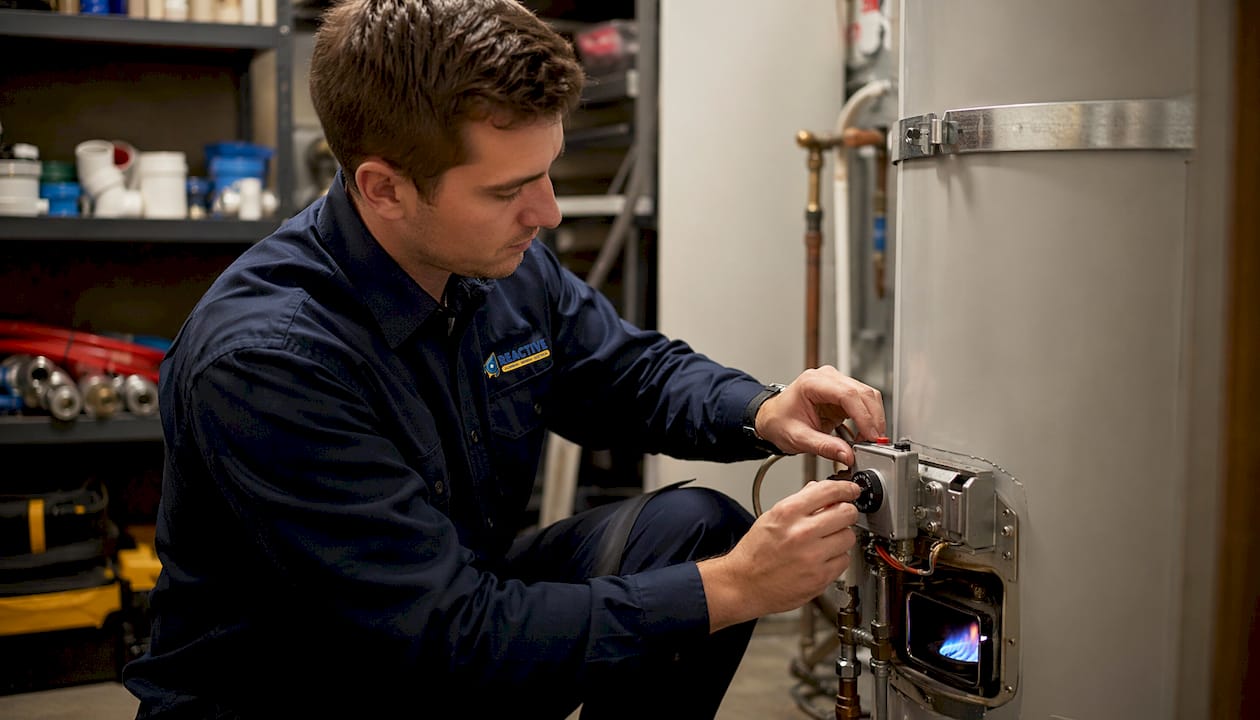
A standing pilot burns continuously and ignites the main burner when hot water is needed. If the pilot has gone out, you will see no flame through the small inspection window on the unit.
Follow these steps to relight it safely:
- Turn the gas control knob to the “Off” position and wait five minutes. This clears any residual gas from the chamber.
- Turn the knob to the “Pilot” position.
- Press and hold the knob down while pressing the igniter button repeatedly until the pilot lights.
- Hold the gas knob down for 30–60 seconds after the pilot lights. This heats the thermocouple enough to keep the gas valve open.
- Release the knob slowly. If the pilot stays lit, turn the knob to your desired temperature setting.
- If the pilot goes out when you release the knob, repeat the process. If it fails after three attempts, the thermocouple is likely faulty.
The thermocouple is a small safety device that senses the pilot flame and keeps the gas valve open. When it fails, the pilot will not stay lit regardless of how many times you relight it. Thermocouple replacement typically costs $80–$150 and requires a licensed gasfitter. That is a minor repair compared to a full system replacement.
Pro Tip: A pilot that keeps going out despite a working thermocouple may be affected by a draught from a nearby vent or a partially blocked pilot jet. Check for air movement around the unit and clean the jet with a fine needle if you can see visible debris. If in doubt, call a licensed gasfitter.
Continuous flow units with electronic ignition
Continuous flow units do not have a standing pilot. They use electronic ignition to light the burner each time you open a hot tap. Common signs of an ignition fault include:
- No clicking sound when you open a hot tap
- Error codes displayed on the unit’s digital panel
- The unit attempts to ignite but the burner does not stay on
- Power supply issues preventing the control board from operating
Check the unit’s display for error codes and consult the manufacturer’s troubleshooting guide for your specific model. Many codes point directly to the fault. If the display is blank, the issue is almost certainly electrical.
What power issues can stop a gas hot water system working?
Many homeowners are surprised to learn that a gas hot water system can fail because of an electrical fault. Modern continuous flow units and some storage systems rely on electricity to power the control board, fan, and ignition system. No power means no hot water, even with a full gas supply.
Start with the switchboard. A tripped circuit breaker labelled “Hot Water” or “HWS” is a common cause of outages. Resetting it may resolve the fault immediately. If the breaker trips again shortly after resetting, there is an underlying electrical fault that needs a licensed electrician.
Other power checks to run:
- Power point: Some units plug into a standard power point. Check that the point is switched on and test it with another appliance.
- Inline switch: Some installations include a dedicated wall switch near the unit. Confirm it is in the on position.
- Batteries: Older continuous flow units use batteries for ignition rather than mains power. Replace them with fresh AA or D-cell batteries as specified in your manual.
- Safety switches: A tripped safety switch (RCD) on the switchboard will cut power to multiple circuits. Reset it and monitor for repeat trips.
Never attempt to open the unit’s electrical components yourself. Electrical safety checks on hot water systems must be carried out by a licensed electrician in Australia.
Can low water flow stop a gas hot water system from igniting?
Low water flow is one of the most overlooked causes of gas hot water heater issues. Continuous flow units need a minimum flow of 2–3 litres per minute to activate the burner. Below that threshold, the flow sensor does not trigger ignition and you get cold water.
Blocked inlet filters or partially closed taps prevent ignition in continuous flow units even when the unit itself is functioning normally. This is a surprisingly common fault that looks exactly like a gas or ignition problem.
Check these flow-related causes:
- Partially closed taps: Open every hot tap fully. A tap turned only halfway reduces flow below the activation threshold.
- Clogged inlet filter: The unit has a small mesh filter on the cold water inlet. Unscrew the inlet connection, remove the filter, and rinse it under running water.
- Blocked tap aerators: Mineral build-up in tap aerators restricts flow. Unscrew the aerator from the tap spout and soak it in white vinegar for 30 minutes.
- Ultra-low-flow shower heads: Some water-saving shower heads deliver less than 2 litres per minute, which is below the ignition threshold. Replacing them with a model rated at 6–7 litres per minute often resolves the fault.
Pro Tip: Test flow rate by filling a bucket from the hot tap for 10 seconds and multiplying the volume by 6. If the result is under 2 litres per minute, flow restriction is your problem.
When should you call a professional for gas hot water repairs?
Some faults are beyond safe DIY troubleshooting. Knowing when to stop and call a licensed gasfitter or plumber protects both your safety and your system.
Call a professional immediately if you notice any of the following:
- Gas smell near the unit: Turn off gas at the meter and call emergency services before anything else.
- Continuous dripping from the pressure relief valve: This indicates thermostat overheating or valve failure and requires urgent assessment.
- Yellow or orange flames: A healthy gas flame is blue. Yellow or orange flames indicate incomplete combustion, which can produce carbon monoxide.
- Soot or scorch marks: Black marks around the burner or flue point to a serious combustion fault.
- Persistent pilot outages: If the pilot will not stay lit after multiple attempts and a thermocouple replacement has not resolved it, the gas valve itself may be faulty.
- Error codes that do not clear on reset: Persistent codes on a Rinnai or similar unit indicate component failure requiring professional diagnosis.
- Water leaks from the unit or pipework: A leaking tank or fittings can indicate the unit is near the end of its service life. Review the signs you should replace your hot water heater before committing to a repair.
On cost, homeowners can expect to pay $150–$400 for a professional diagnostic and minor repair, or $1,800–$4,500 for a full system replacement. Catching faults early almost always keeps costs at the lower end of that range.
Key takeaways
Gas hot water not working on a gas system almost always traces back to one of four causes: gas supply interruption, pilot light or ignition failure, power loss, or insufficient water flow.
| Point | Details |
|---|---|
| Check gas supply first | Test another gas appliance before diagnosing the hot water unit itself. |
| Hold pilot knob for 30–60 seconds | Insufficient thermocouple heating is the most common reason a pilot will not stay lit. |
| Power matters for gas units | A tripped circuit breaker or flat batteries can stop a gas system from igniting. |
| Flow rate triggers ignition | Continuous flow units need at least 2–3 litres per minute to activate the burner. |
| Know when to stop DIY | Gas smell, yellow flames, or persistent faults require a licensed gasfitter, not more troubleshooting. |
What I have learned from years of gas hot water call-outs
After years of attending gas hot water call-outs across Sydney, Newcastle, and Brisbane, the pattern is consistent. Homeowners who call us earliest spend the least. The ones who wait, hoping the problem resolves itself, often end up with a full replacement instead of a $150 repair.
The most common mistake I see is homeowners skipping the gas supply check entirely. They assume the gas is fine because the system was working yesterday. But a partially closed isolation valve, a tripped regulator, or an empty LPG cylinder can happen overnight. Two minutes at the meter would have saved them an hour of unnecessary troubleshooting.
The second mistake is ignoring a gas smell and pressing on anyway. I understand the frustration of no hot water, especially with a family at home. But a gas leak is not a problem you troubleshoot. You leave the house, turn off the meter, and call for help. No shower is worth that risk.
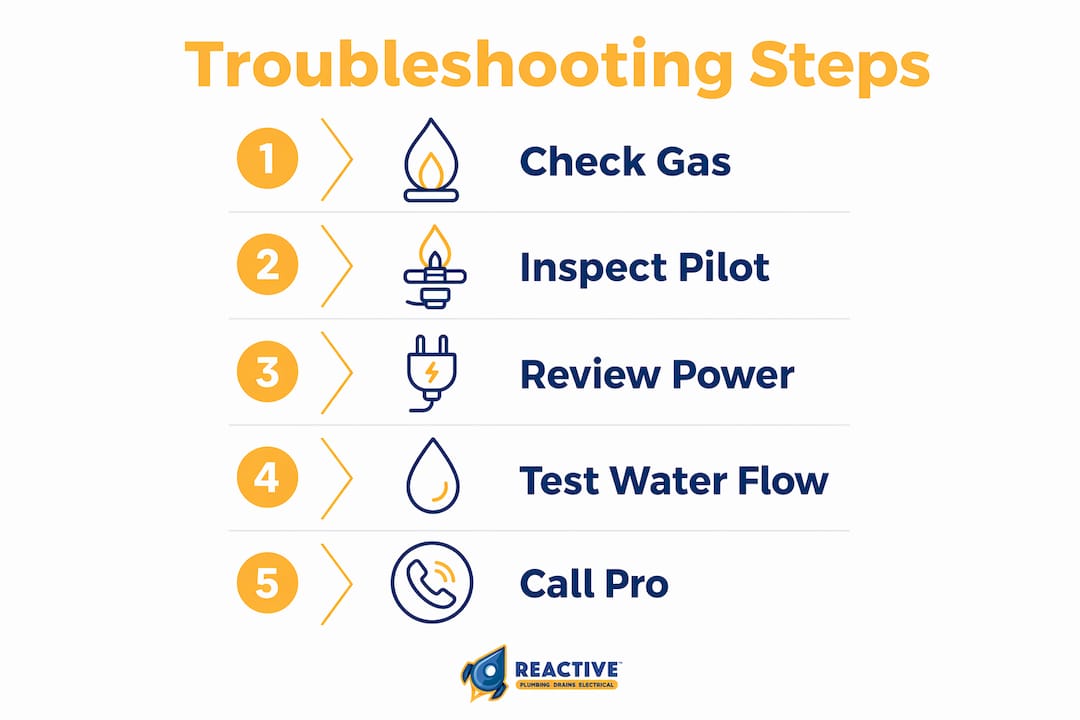
My honest advice: work through the four checks in order, gas supply, pilot or ignition, power, then flow. If you clear all four and still have no hot water, the fault is internal and needs a professional. A good tradie will diagnose it quickly. The common heating system faults that stump homeowners are usually straightforward for a licensed technician with the right tools.
Regular servicing every two to three years also makes a real difference. A technician will catch a deteriorating thermocouple or a partially blocked pilot jet before it becomes a cold-shower emergency.
— Brent
Gas hot water repairs from Reactive Plumbing & Electrical
If you have worked through every check in this guide and your system is still not producing hot water, the fault needs a licensed professional.

Reactive Plumbing & Electrical provides 24/7 emergency hot water system repairs and replacements across Sydney, Newcastle, Wollongong, Brisbane, Ipswich, and the Gold Coast. Our licensed gasfitters and plumbers carry the parts and equipment to diagnose and fix most faults on the first visit. Whether your unit needs a thermocouple swap, a full system replacement, or a gas line inspection, we handle it safely and to Australian standards. Contact Reactive Plumbing & Electrical to book a same-day assessment and get your hot water back on quickly.
FAQ
Why does my gas hot water system have no hot water suddenly?
Gas supply interruptions and power outages are the most common causes of sudden hot water loss. Check that other gas appliances work and that no circuit breakers have tripped before inspecting the unit itself.
How do I relight the pilot light on my gas hot water system?
Turn the gas knob to “Pilot,” press and hold it while pressing the igniter, then hold the knob down for 30–60 seconds after the flame appears. Releasing too early is the most common reason the pilot goes out again immediately.
Why does my continuous flow gas hot water system not ignite?
Blocked inlet filters or partially closed taps reduce flow below the 2–3 litre per minute minimum needed to trigger ignition. Clean the inlet filter and open all hot taps fully before checking ignition components.
Is it safe to troubleshoot a gas hot water system myself?
Basic checks like testing gas supply, resetting a circuit breaker, and cleaning an inlet filter are safe for homeowners. If you smell gas, stop all activity, turn off the gas at the meter, and contact emergency services immediately.
How much does it cost to repair a gas hot water system?
Professional diagnostics and minor repairs typically cost $150–$400. Full system replacement ranges from $1,800 to $4,500 depending on the unit type and installation complexity.