What size water heater for a 3 bedroom house?
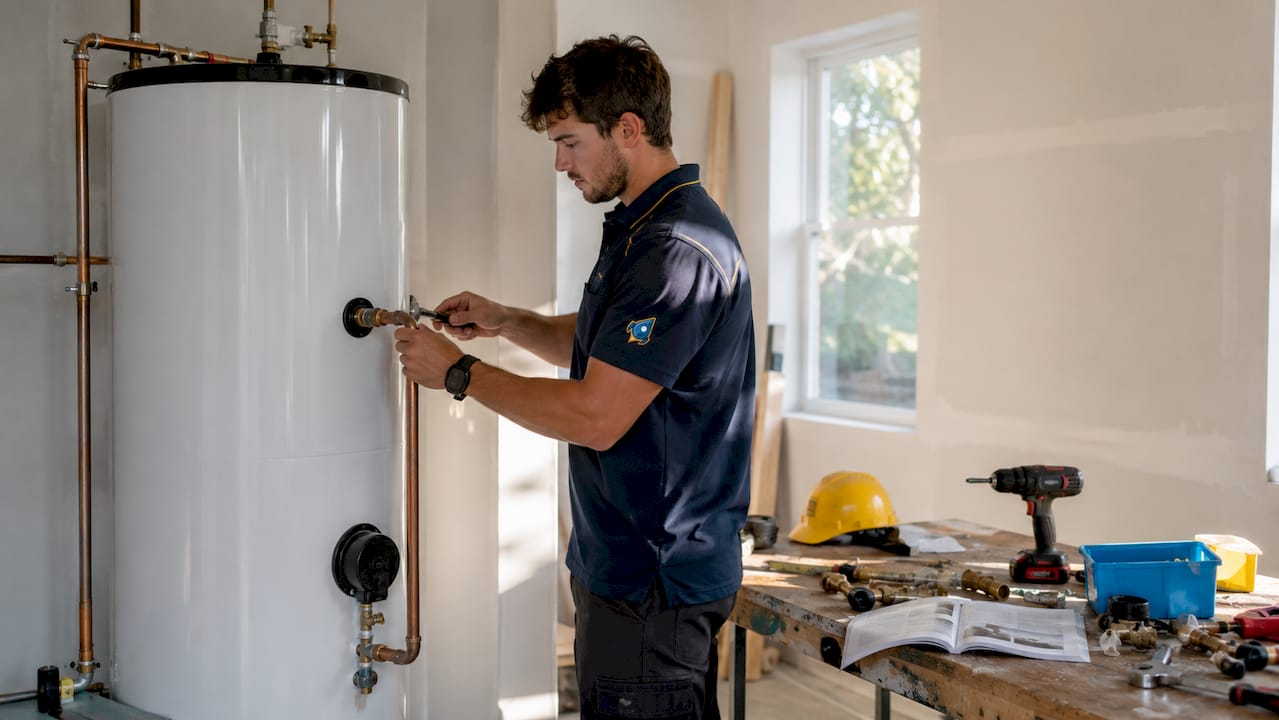
The ideal water heater size for a 3 bedroom house is a 250–315 litre storage tank or a continuous flow unit rated at 26–32 litres per minute. These figures cover a typical household of 3–4 occupants and align with current Australian industry practice as of 2026. Get the sizing wrong and you will either run out of hot water on a cold winter morning or pay to heat water you never use. The good news is that choosing the right capacity is straightforward once you understand what actually drives demand in your home.
What size water heater does a 3 bedroom house need?
A 315 litre storage tank is the recommended capacity for a 3–4 person household to guarantee reliable hot water supply. That figure sits at the upper end of the 250–315 litre range, and the extra volume acts as a buffer during peak morning demand. For continuous flow gas systems, a unit rated at 26–32 L/min supports two showers running simultaneously without a temperature drop.
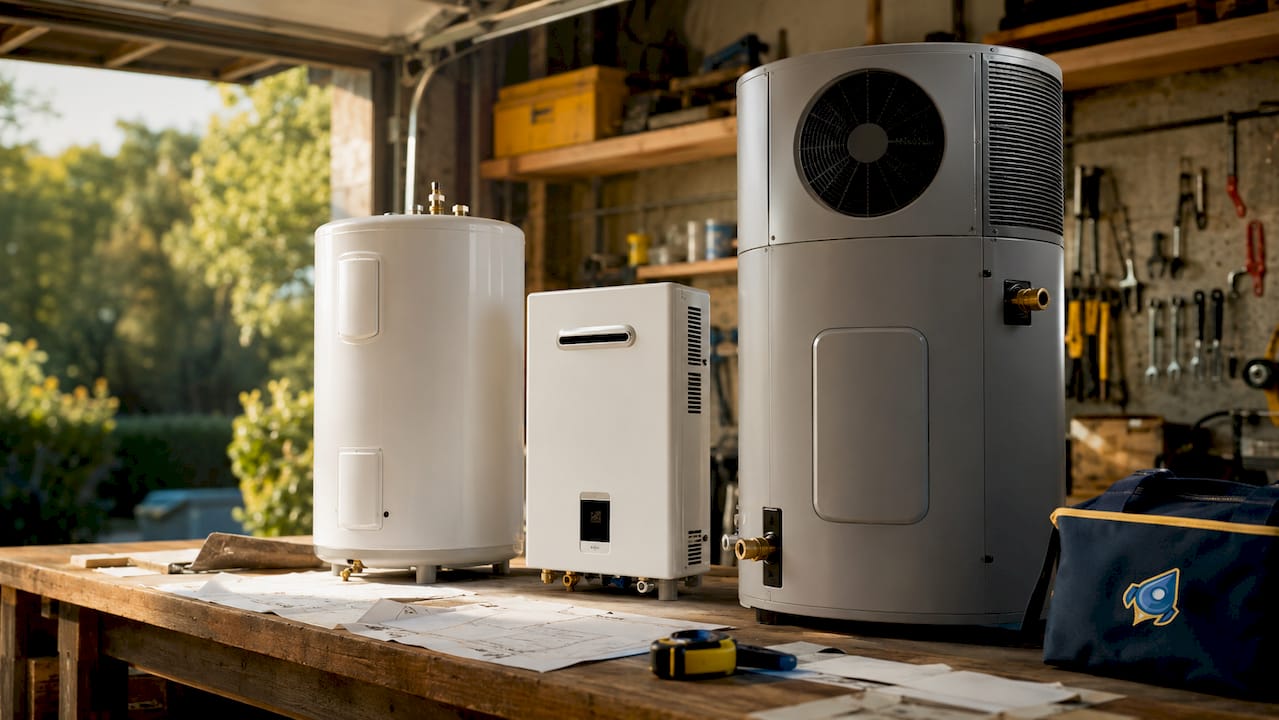
Bedroom count alone is not the right measure. Typical water heater sizes range from 25 litres to 400 litres, and the correct choice depends on usage patterns, not just how many rooms the house has. A 3 bedroom home with a family of five has very different needs from the same house occupied by two adults.
How does household usage affect water heater capacity?
Peak demand is the real sizing challenge. Most households hit their highest hot water draw in the morning, when multiple people shower, the dishwasher runs from the night before, and someone starts a load of laundry. A system sized only for average daily use will fall short during these bursts.
The Australian standard AS/NZS 3500.4:2025 addresses this directly. It uses a fixture unit rating method to calculate simultaneous demand rather than relying on occupant count. Under this method, a shower is rated at 4 fixture units and a bath at 10 fixture units. Adding up the fixtures in your home gives a far more accurate picture of peak load than simply counting bedrooms.
Here is what a typical 3 bedroom household scenario looks like in practice:
- Two bathrooms with showers, one bath: High simultaneous demand in the morning; a 315 litre tank or a 26 L/min continuous flow unit is the minimum.
- Three bathrooms: Simultaneous use becomes more likely; size up to 315 litres or choose a 32 L/min continuous flow unit.
- Dishwasher and washing machine in daily use: Add roughly 15–20 litres of hot water demand per cycle to your calculations.
- Teenagers in the household: Longer shower times increase daily volume; lean toward the top of the recommended range.
Pro Tip: Count every hot water outlet in your home before choosing a system. Taps, showers, baths, dishwashers, and washing machine connections all contribute to your peak fixture unit load under AS/NZS 3500.4:2025.
Storage tanks vs continuous flow: which suits a 3 bedroom home?
Both system types can serve a 3 bedroom house well. The right choice depends on your home’s layout, gas or electricity connection, and how your family uses hot water through the day.
| Feature | Storage tank | Continuous flow |
|---|---|---|
| Capacity | 250–315 litres for 3–4 people | 26–32 L/min flow rate |
| Energy use | Standby heat loss between cycles | Heats only on demand |
| Recovery time | 1–4 hours depending on fuel type | Instant, no recovery needed |
| Space required | Larger footprint, indoor or outdoor | Compact, wall-mounted |
| Best for | Households with predictable peak use | Homes with variable or spread-out demand |
| Climate consideration | Heat pumps need upsizing in colder zones | Gas units perform consistently in all zones |
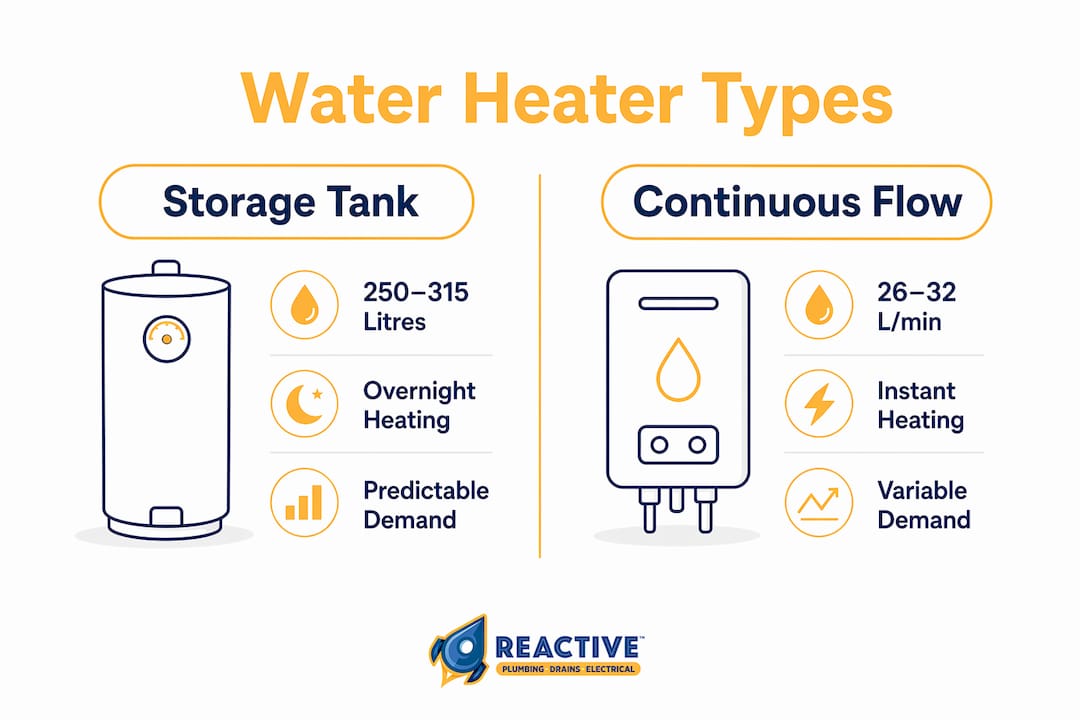
Storage tanks work well when your household follows a predictable routine. The tank heats a full volume overnight or during off-peak hours and holds it ready for the morning rush. The trade-off is standby heat loss, where the stored water gradually cools and the system reheats it even when no one is using hot water.
Continuous flow units, sometimes called instantaneous or tankless systems, heat water only when a tap is opened. They suit homes where demand is spread across the day rather than concentrated in one peak period. A compact continuous flow model installed near outlets also reduces the length of pipe between the heater and the tap, which cuts both water waste and heat loss.
Pro Tip: If your 3 bedroom home has bathrooms at opposite ends of the building, a continuous flow unit installed centrally, or two smaller units placed near each bathroom cluster, will outperform a single large storage tank on hot water delivery speed.
Heat pump systems deserve a special mention. They are highly energy efficient but have slow recovery times of 3–5 hours, which means running out of hot water during an unexpectedly busy morning is a real risk if the tank is undersized. In colder Australian climate zones, heat pumps also work harder and recover more slowly, making upsizing from 250 litres to 315 litres a practical necessity rather than a luxury.
Practical tips for sizing correctly and avoiding common mistakes
Getting the sizing right the first time saves you money and frustration. These are the most common mistakes we see, and how to avoid them.
Size up, not down. Sizing up causes minimal additional running cost but significantly reduces the risk of running out of hot water during peak demand. A 315 litre tank costs only marginally more to run than a 250 litre tank, but the reliability difference is significant.
Account for future changes. A couple planning to start a family, or a household expecting a teenager to move back in, should size for the anticipated occupancy rather than the current one. Replacing a water heater is a real cost you want to avoid doing twice in five years.
Check your pipe layout. Long pipe runs between the heater and the tap waste water and energy. Installing a recirculation loop in a larger home delivers hot water faster at distant taps and reduces water waste more effectively than simply increasing the heater’s tank size.
Do not undersize a heat pump. Heat pump water heaters have slower recovery times than gas systems. Undersizing leads to perpetual recovery cycles and faster system wear, and in colder zones the problem compounds significantly.
Get a licensed installer to confirm your sizing. The AS/NZS 3500.4:2025 fixture unit method requires knowledge of your specific plumbing layout. A licensed plumber can calculate your peak demand accurately and recommend the right system for your home.
Pro Tip: Ask your installer to check the distance from the heater to the furthest hot water outlet. If it exceeds 10 metres, a recirculation loop or a point-of-use unit at that outlet will improve your experience far more than upgrading to a larger tank.
How does energy efficiency factor into your sizing decision?
Correct sizing and energy efficiency go hand in hand. An oversized system wastes energy through standby losses. An undersized system runs recovery cycles constantly, which also wastes energy and shortens the unit’s life.
The most significant efficiency gain available to Australian homeowners right now is pairing a larger storage tank with solar panels. Larger tanks paired with solar serve as energy storage, maximising the use of solar-heated water and reducing electricity consumption during evening hours when the sun is not shining. A 315 litre tank heated during peak solar generation hours can carry a household through the entire evening without drawing from the grid.
Key efficiency considerations for a 3 bedroom home include:
- Energy star ratings: Higher-rated systems cost more upfront but reduce running costs over the system’s life. Compare the annual running cost figure on the energy label, not just the purchase price.
- Standby losses in storage tanks: Well-insulated tanks lose less heat overnight. Check the tank’s insulation rating before purchasing.
- Recirculation loop efficiency: A recirculation system reduces the time you run the tap waiting for hot water to arrive, which cuts both water waste and the energy used to heat that wasted water.
- Climate zone matching: Heat pumps perform best in warmer Australian climates. In cooler southern regions, a gas storage or continuous flow system may deliver better year-round efficiency.
- Off-peak tariffs: Electric storage tanks can be set to heat during off-peak electricity periods, reducing running costs significantly without any change to the tank size.
Key takeaways
A 315 litre storage tank or a 26–32 L/min continuous flow unit is the right starting point for a 3 bedroom house with 3–4 occupants, but accurate sizing requires applying the AS/NZS 3500.4:2025 fixture unit method to your specific home layout.
| Point | Details |
|---|---|
| Recommended tank size | A 315 litre storage tank covers 3–4 occupants and handles peak morning demand reliably. |
| Continuous flow alternative | A 26–32 L/min unit supports two simultaneous showers without temperature loss. |
| Use the fixture unit method | AS/NZS 3500.4:2025 calculates peak demand by fixture type, not bedroom count. |
| Size up for heat pumps | Heat pumps recover slowly; always choose 315 litres over 250 litres in a 3 bedroom home. |
| Solar pairing works best with larger tanks | A 315 litre tank stores solar-heated water through the evening, reducing grid electricity use. |
Brent’s take on sizing water heaters for 3 bedroom homes
After years of installing hot water systems across Sydney and the surrounding regions, the single most common mistake I see is homeowners choosing a system based on what the previous one was, rather than what their household actually needs now. A family of four with two teenagers has completely different peak demand from the couple who lived there before them, even in the same 3 bedroom house.
The other thing I see regularly is people undersizing heat pump systems because they are focused on the upfront cost. Heat pumps are genuinely excellent systems, but they are unforgiving when undersized. A 250 litre heat pump in a busy household will run recovery cycles almost constantly, and the system wears out faster than it should. The signs of a failing hot water system often trace back to years of operating under that kind of strain.
My honest advice is to treat the 315 litre figure as your floor, not your ceiling, for a 3 bedroom home with a full household. The marginal cost difference between 250 and 315 litres is small. The difference in reliability over ten years is not.
— Brent
Reactive Plumbing & Electrical: hot water sizing you can rely on
Choosing the right hot water system for your home is easier with a licensed professional who knows your local area and your home’s specific layout.
Reactive Plumbing & Electrical works with homeowners across Sydney, Newcastle, Wollongong, Brisbane, Ipswich, and the Gold Coast to recommend and install the right system for their household. Whether you need a hot water system in Kellyville or advice on heat pump sizing for a larger home, our licensed team assesses your plumbing layout, occupancy, and energy setup before recommending anything. We also offer 24/7 emergency hot water services, so if your current system fails, we are ready to help right away.
FAQ
What is the right tank size for a 3 bedroom house?
A 315 litre storage tank is the recommended size for a 3 bedroom house with 3–4 occupants. It provides enough capacity to handle peak morning demand without running out of hot water.
Is a continuous flow system better than a storage tank for 3 bedrooms?
Neither is universally better. A continuous flow unit rated at 26–32 L/min suits homes with spread-out demand, while a 315 litre storage tank works well for households with a predictable morning peak.
How do I calculate how much hot water my family needs?
The AS/NZS 3500.4:2025 fixture unit method assigns a rating to each hot water outlet in your home, such as 4 units for a shower and 10 units for a bath, and totals them to calculate peak simultaneous demand.
Can I use a heat pump water heater in a 3 bedroom house?
Yes, but size it at 315 litres rather than 250 litres. Heat pumps have recovery times of 3–5 hours, so a larger tank reduces the risk of running out of hot water during busy periods.
Does solar work with a standard hot water tank?
A 315 litre storage tank pairs well with solar panels by storing solar-heated water through the evening, reducing reliance on grid electricity during off-peak hours.