
Urgency fee for plumbing
You’ve just found water spreading across your kitchen floor at 11pm on a Sunday, and you need a plumber right now. When the tradesperson quotes you a price that’s double what you’d normally expect, you’re left wondering: what is an urgency fee for plumbing, and is it actually justified? That confusion is completely understandable. Urgency fees are one of the least explained line items in any home repair bill, yet they show up when you’re at your most stressed. This guide breaks down exactly what these fees cover, what’s reasonable to expect, and how to avoid being caught off guard.
Table of Contents
- Key takeaways
- What an urgency fee actually covers
- Typical urgency fees and costs in Australia
- When an urgency fee is worth paying
- Standard charges vs urgency fees
- My take on urgency fees after years on the tools
- Need a plumber you can trust in an emergency?
- FAQ
Key takeaways
| Point | Details |
|---|---|
| Urgency fees reflect real costs | After-hours availability, travel, and immediate dispatch all add genuine overhead to emergency plumbing calls. |
| Pricing varies by time and day | Labour rates for nights, weekends, and public holidays can be 1.5 to 3 times the standard daytime rate. |
| Minimum billing applies | Most emergency plumbers bill a minimum of 1 to 2 hours, regardless of how quickly the job is done. |
| Not all surcharges are fair | A quote exceeding 2.5 times the standard rate is a red flag worth investigating before you agree. |
| Preparation reduces surprises | Having a trusted, licenced plumber on call and keeping a small emergency fund can significantly reduce cost shock. |
What an urgency fee actually covers
When you see an urgency fee on a plumbing invoice, it can feel arbitrary. It rarely is. That fee bundles several distinct costs that simply don’t apply to a scheduled daytime appointment.
The first component is the callout or service fee. This covers the plumber’s travel time, fuel, and the initial assessment of your property. You’re paying for a licenced tradesperson to drop everything, load their van, and head to your address, often in the middle of the night.
The second and often largest component is the higher labour rate. Emergency labour rates are significantly higher than standard rates, often 1.5 to 3 times the daytime rate depending on the time and urgency. A weeknight call-out might attract a 1.5x multiplier, while a Sunday or public holiday can push that to 2.5x or higher.
Then there’s the minimum billing policy. Most emergency plumbers apply a minimum 1 to 2 hours of labour, even if your burst tap is fixed in 25 minutes. A 2-hour minimum at $200 per hour adds $400 to your bill before parts are even discussed. That’s not a trick. It’s standard practice to make emergency callouts financially viable for the business.
Beyond labour, there’s a real overhead cost to running a 24/7 operation. Staffing on-call plumbers, maintaining a ready fleet of vehicles, and managing immediate dispatch logistics all carry ongoing expense. That cost gets reflected in what you pay.
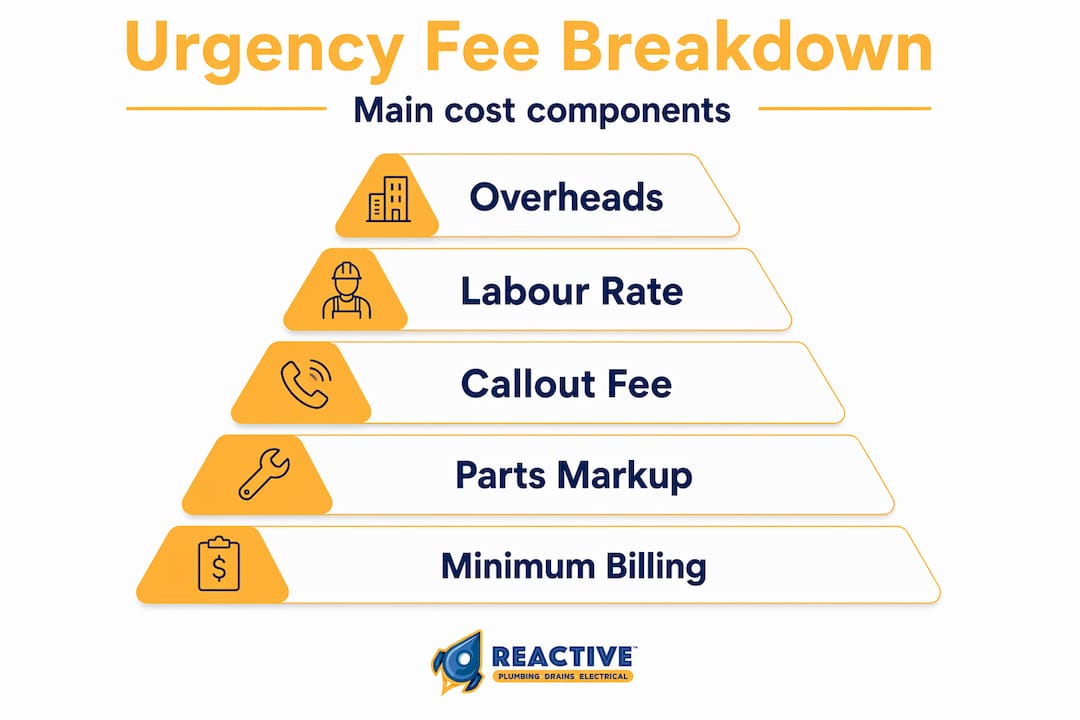
Parts markups are also common in emergency scenarios. If a plumber needs to source a specific part outside business hours, they may pay a premium to get it quickly. That’s usually passed on.
Pro Tip: Ask your plumber to itemise the invoice separately, showing callout fee, labour rate, minimum billing time, parts, and any surcharge. Transparent billing like this is a sign of a trustworthy operator and helps you understand exactly what you’re paying for.
Typical urgency fees and costs in Australia
Understanding typical numbers helps you know whether a quote is fair before you agree to anything.
For standard business hours callouts, you might expect a callout fee of around $80 to $150, plus labour at roughly $100 to $150 per hour. Outside those hours, the picture changes significantly. Typical emergency callout fees range from $150 to $250, with labour rising sharply for after-hours work.
Here’s a comparison of what you might see on a bill for a common repair like fixing a burst flexi-hose under a sink:
| Repair type | Standard daytime rate | After-hours urgency rate |
|---|---|---|
| Burst flexi-hose (under sink) | $200 to $350 | $450 to $700 |
| Blocked drain | $250 to $400 | $500 to $800 |
| Leaking tap | $150 to $280 | $350 to $550 |
| Hot water system fault | $300 to $600 | $600 to $1,200 |
| Sewage backup | $400 to $700 | $800 to $1,500 |
For more complex emergencies, total repair costs typically fall between $300 and $1,500, with complex cases like a broken pipe behind a wall or a failed hot water system exceeding $3,500.
The numbers can look steep at first glance. But emergency plumbing services often cost 75 to 150 per cent more than scheduled daytime repairs. Knowing that going in means you’re less likely to be shocked and more likely to make a clear-headed decision.
Pro Tip: Before the job starts, ask directly: “What is your callout fee, what is your after-hours hourly rate, and do you have a minimum billing time?” Any reputable plumber will answer all three questions without hesitation. If they can’t give you a straight answer, that tells you something important.
When an urgency fee is worth paying
The honest answer? Usually it is. Here’s how to think about it clearly under pressure.
There are certain situations where calling an emergency plumber without hesitating is the right call:
- Active flooding or a burst pipe releasing water into your home. Water causes structural damage fast, and every hour of delay compounds the repair cost.
- Sewage backup into your home. This is a health issue, not just a plumbing issue. Raw sewage carries serious bacteria and can render parts of your home unusable.
- Suspected gas leaks anywhere near plumbing or hot water systems. Leave the building, call the gas company, and call a licenced plumber immediately.
- Loss of hot water in winter for households with young children, elderly residents, or anyone with a medical need for warm water.
- A dripping tap that suddenly becomes a gush with no isolating valve accessible to shut it off.
For situations that are inconvenient but not actively causing damage, it may be worth waiting until business hours. A slow drain or a running toilet cistern can usually hold until morning without doing much harm.
The “damage maths” framework is useful here. Think of it this way: if a plumber charges an $800 urgency fee to fix a burst pipe at midnight, and delaying that repair for 12 hours might cause thousands in structural damage, the urgency fee is cheap insurance. Water sitting behind walls, under floors, or in roof cavities for 24 to 48 hours can turn a $300 repair into a $50,000 restoration project.
Comparing the potential cost of damage over time against urgency fees helps homeowners make rational decisions under pressure. Source
You can also reduce the likelihood of needing emergency calls at all by staying on top of routine maintenance. Knowing whether to call a licenced plumber or attempt a DIY fix is another important part of that equation, particularly in situations where well-meaning DIY attempts escalate a minor issue into a true emergency.
Standard charges vs urgency fees
Understanding the difference between a regular plumbing invoice and an emergency one helps you spot fair pricing and avoid being overcharged.
During business hours, a plumber sets a base rate for labour and a standard callout fee. Both are predictable and competitive because you have the time to get multiple quotes. Emergency situations remove that option, which is exactly why a premium is charged.
A reasonable after-hours surcharge typically adds 25 to 75 per cent on top of standard rates, with true emergencies such as burst mains or sewage overflows attracting 50 to 150 per cent above the daytime rate. That’s the normal range. Outside it, you should ask questions.
Red flags that suggest a quote is unfair include:
- A quote that exceeds 2.5 times the standard daytime rate without clear explanation
- Refusal to provide an itemised quote before work begins
- Pressure to sign off immediately without reviewing costs
- No mention of a callout fee upfront, only revealed on the final invoice
- No licence number offered or available on the website
Communicating clearly in an emergency can be difficult, but it matters. Clear communication with your plumber before they start work, confirming the scope, rate, and minimum billing, protects you from disputes after the job is done.
The most practical protection you have is having a trusted, licenced plumber’s number saved before you ever need them. Transparent quotes that list labour, parts, callout fees, and surcharges separately are standard practice for reputable operators. If a plumber won’t give you that, look elsewhere even if it means a short delay.
Pro Tip: Save the contact details of a licenced local plumber now, before an emergency happens. When water is spreading across your floor at midnight, you’ll make a much better decision if you’re calling a trusted name rather than searching under pressure.
My take on urgency fees after years on the tools
I’ve had many conversations with homeowners who were frustrated by their emergency plumbing bill. In almost every case, that frustration came from surprise, not from the fee itself being unreasonable. When someone feels blindsided by a cost, no amount of explaining changes how it lands.
In my experience, the plumbers who handle this best are the ones who name the fee structure on the phone before they even head out. “Our callout fee tonight is $200, our after-hours rate is $180 per hour, and we have a one-hour minimum.” That sentence takes fifteen seconds to say and prevents nearly every dispute.
What I’ve seen when homeowners delay calling because of the cost is often far worse than the fee they were trying to avoid. A slow leak left overnight while someone searched for a cheaper option has resulted in flooded subfloors and mould remediation that cost twenty times the original urgency fee. The maths rarely favours waiting.
My honest advice: view understanding urgency fees as part of how you manage your home, the same way you’d think about contents insurance or a smoke alarm battery. It’s not a cost you want. It’s a cost you’re grateful exists when you genuinely need it.
If the fee feels excessive, ask for the itemised breakdown before work begins. A licensed, professional operator will give it to you without hesitation. That’s the moment when you find out whether you’re dealing with someone worth trusting.
Need a plumber you can trust in an emergency?
At Reactive Plumbing & Electrical, we believe that clear pricing is part of the service. Before we start any emergency job, we tell you exactly what the callout fee is, what the after-hours rate is, and how minimum billing applies. No surprises on the invoice.

Our licensed team covers Sydney, Newcastle, Wollongong, Brisbane, Ipswich, and the Gold Coast, with 24/7 availability and a fully equipped fleet ready to respond. Whether you’re dealing with a burst pipe at midnight or a blocked drain on a public holiday, we’re the local team you can call with confidence. Check out our emergency plumbing services or use our home maintenance checklist to reduce the chances of needing us urgently in the first place. Either way, we’re here when it matters.
FAQ
What is an urgency fee for plumbing?
An urgency fee for plumbing is an additional charge applied when a plumber is called outside standard business hours or for an immediate response. It covers higher labour rates, callout costs, and the overhead of maintaining 24/7 availability.
How much is an urgency fee in Australia?
Callout fees for emergency plumbing in Australia typically range from $150 to $250, with after-hours labour rates running 1.5 to 3 times the standard daytime rate depending on the time of day and day of the week.
Is it worth paying an urgency fee for a plumbing emergency?
Yes, in situations involving active flooding, sewage backup, or a burst pipe. Delaying repairs can turn a manageable fix into thousands of dollars in structural damage, making the urgency fee a worthwhile cost by comparison.
How do I know if an urgency fee is too high?
If a quote exceeds 2.5 times the standard daytime rate or the plumber refuses to provide an itemised breakdown before starting work, those are signs the pricing may be unreasonable and worth questioning before you agree.
Can I reduce emergency plumbing costs?
Yes. Regular maintenance reduces the likelihood of emergencies, and having a licenced plumber’s contact saved in advance means you won’t be searching under pressure. An emergency repair fund of even a few hundred dollars also takes the sting out of urgency fees when they do arise.