Got a Rinnai but no hot water? Potential causes, fixes, and when to call
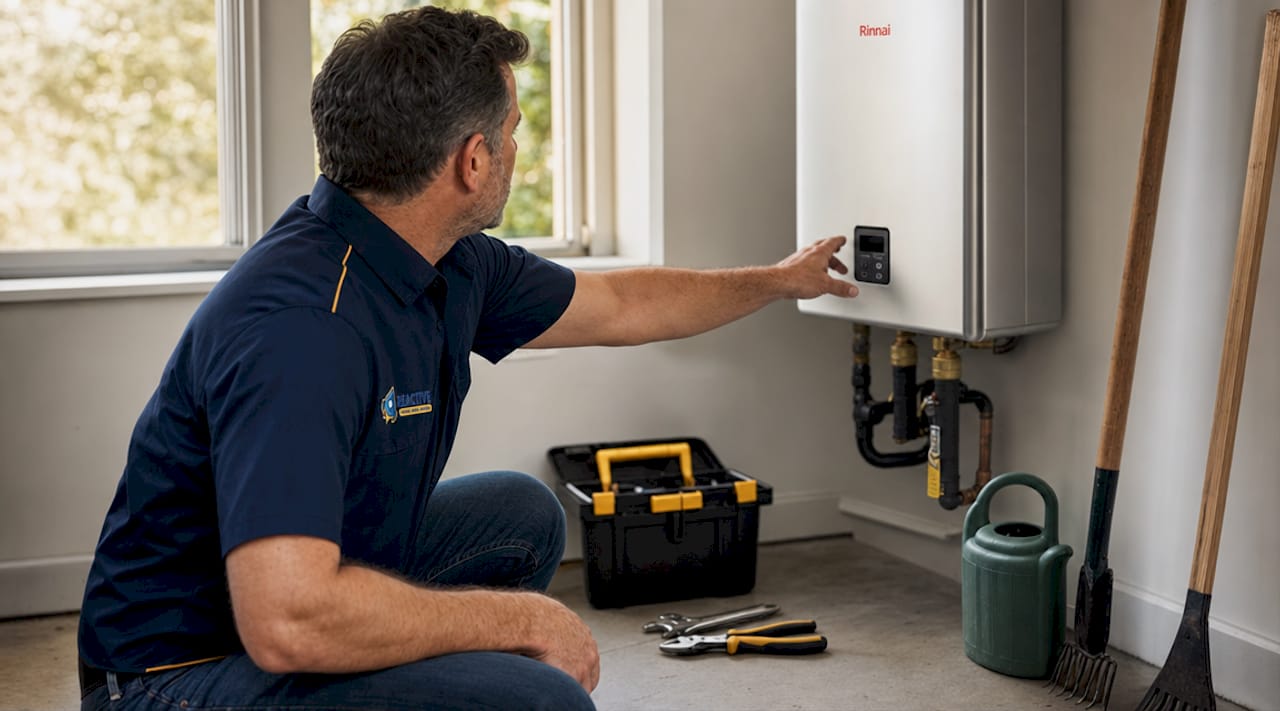
Rinnai no hot water is defined as a condition where your Rinnai tankless hot water system fails to ignite or heat water, typically due to a gas supply fault, insufficient water flow, an ignition error, or scale build-up in the heat exchanger. Rinnai tankless units (also called continuous flow or instantaneous hot water systems) rely on a flow sensor to detect water movement before the burner fires. If that sensor doesn’t register adequate flow, or if the ignition sequence fails, you get cold water at every tap. The good news is that Rinnai’s built-in self-diagnostic error codes tell you exactly which subsystem has failed, which means you can often pinpoint the problem before calling anyone.
What does rinnai no hot water actually mean?
Rinnai tankless systems are designed to heat water on demand. The unit detects flow, opens the gas valve, ignites the burner, and heats the water as it passes through the heat exchanger. When any one of those steps breaks down, the result is no hot water at all.
Common symptoms include cold water from every tap, the unit powering on but not firing, an error code flashing on the controller display, or the unit clicking repeatedly without igniting. These are all signs of a Rinnai hot water not working situation rather than a plumbing fault elsewhere in your home.
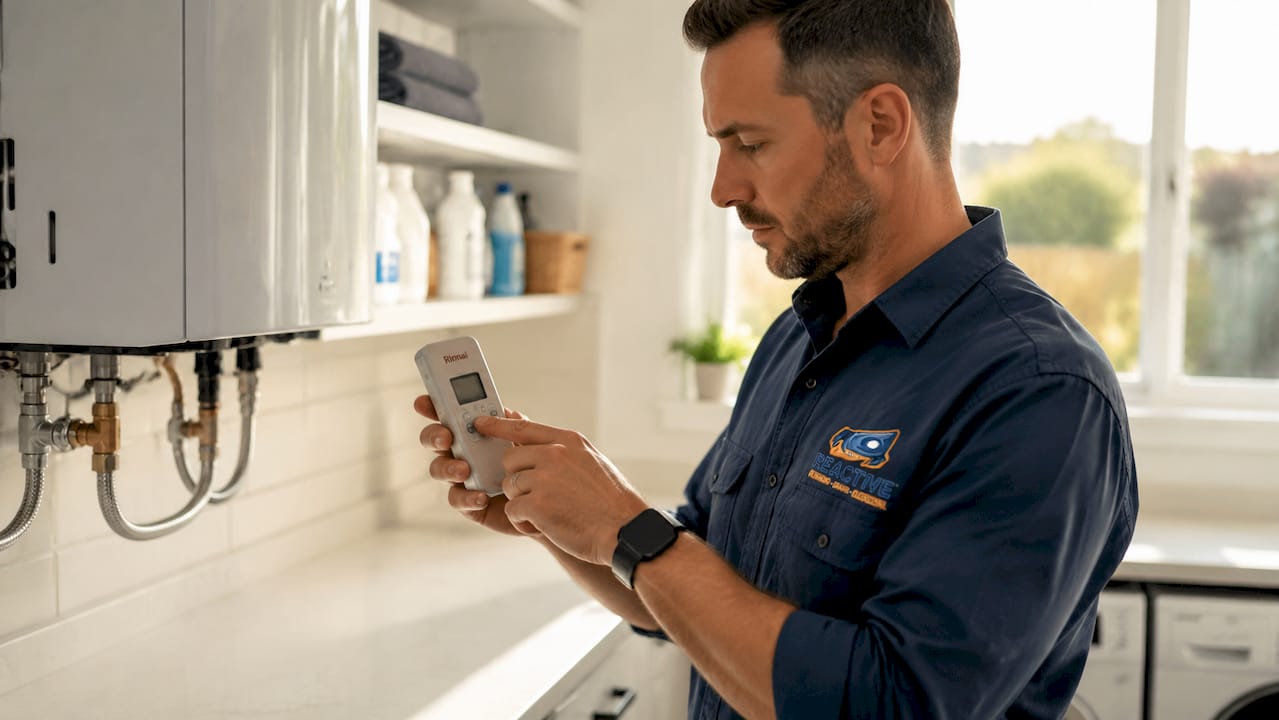
The most telling indicator is the error code. Rinnai’s self-diagnostic system uses numbered codes to identify the exact fault, which means troubleshooting a Rinnai system is far more targeted than guessing with older storage tank heaters. Read the code first. Everything else follows from there.
How to interpret Rinnai error codes for no hot water
Reading the error code displayed on your Rinnai controller is the single most important step before touching anything else. Each code points to a specific subsystem, which saves you time and prevents unnecessary part replacements.
The five most common codes linked to no hot water are listed below.
| Error code | Cause | Suggested next step |
|---|---|---|
| 11 | Ignition failure. Unit attempts to light but cannot. | Check gas supply, gas valve position, and venting. |
| 12 | Flame failure after ignition. Burner lights then cuts out. | Inspect gas pressure, burner condition, and flame sensor. |
| 10 | Blocked exhaust or air supply. Burner shuts down for safety. | Check flue pipe and air intake for blockages or bird nests. |
| 14 | Thermal fuse activation. Overheat protection triggered. | Allow unit to cool, then reset. Call a technician if it recurs. |
| LC | Lime scale build-up in heat exchanger. Efficiency impaired. | Schedule a descaling service before the unit locks out. |
Code 12 flame failure is particularly common and can be caused by low gas pressure, a dirty burner, incorrect venting, or a faulty flame sensor. Code 11 ignition failure often points to a gas supply problem or a blocked flue. Reading the exact code before troubleshooting is what separates a 10-minute fix from an hour of guesswork.
Checking gas supply and ignition for Rinnai hot water not working
Once you have your error code, the gas supply and ignition system are the first physical checks to make. These are the most common causes of a Rinnai heater not firing, and most of them are straightforward to verify yourself.
Work through the following checks in order:
- Gas valve position. The valve on the gas line feeding your unit must be fully open. A partially closed valve restricts gas pressure and prevents ignition.
- Other gas appliances. Turn on your stove or gas cooktop. If those aren’t working either, the issue is with your gas supply, not the Rinnai unit.
- Priority LED status. A steady green priority LED on Rinnai RL75 and similar models confirms the unit has power and is ready to fire. If it’s off or flashing, check the power supply first.
- Power supply. Confirm the unit is plugged in or that the circuit breaker hasn’t tripped. A power interruption can cause the unit to lock out without displaying an obvious fault.
- Venting and flue. A blocked or incorrectly installed flue can cause the unit to shut down on safety. Check that the exhaust pipe is clear and hasn’t been obstructed by debris, a bird nest, or a damaged cap.
Pro Tip: Rinnai tankless units are calibrated for either natural gas or LPG. Using the wrong gas type, or having gas pressure outside the recommended range, will cause persistent ignition failures. If you’ve recently switched gas suppliers or had a new bottle connected, confirm the pressure is correct for your model.
After completing these checks, power cycle the unit by switching it off at the wall or flipping the circuit breaker for 30 seconds, then restore power. This clears minor faults and allows the ignition sequence to restart cleanly.
Why flow rate matters and how to fix low flow
Many homeowners assume a Rinnai hot water issue is always a burner or gas problem. In reality, insufficient water flow is one of the most common causes of no hot water, and it’s one of the easiest to fix yourself.
Rinnai tankless units require a minimum flow rate of approximately 1.5 to 2.3 litres per minute to activate the flow sensor and trigger the burner. Below that threshold, the unit simply won’t fire. This is a safety feature, not a fault.
Follow these steps to diagnose and clear flow restrictions:
- Turn on multiple taps at once. If the unit fires when two or three taps are open but not when only one is, the flow from a single tap is below the activation threshold. This points to a restriction at the fixture, not the unit itself.
- Locate the cold water inlet filter. This is a small mesh screen inside the cold water inlet connection on the unit. A clogged inlet screen is the most common flow-related cause of no hot water. Shut off the cold water supply, unscrew the inlet connection, remove the screen, and rinse it under running water.
- Clean tap aerators and showerheads. Scale and debris accumulate in tap aerators and showerheads over time, reducing flow at the fixture without any obvious signs. Unscrew the aerator from the tap spout and soak it in white vinegar for 30 minutes to dissolve mineral build-up.
- Check your water pressure. If pressure across your home is generally low, the issue may be at the metre or pressure limiting valve rather than the Rinnai unit.
- Inspect for scale in the heat exchanger. If you live in a hard water area and the LC error code has appeared previously, scale inside the heat exchanger may be restricting flow internally.
Pro Tip: Don’t just check the inlet filter on the unit. Walk through every tap and showerhead in the house and check for scaling. A single blocked aerator in the bathroom can be enough to drop flow below the activation threshold, especially in older homes with partially scaled pipes.
When and how to reset your Rinnai tankless water heater
A reset is sometimes all that’s needed to clear a temporary fault, particularly after a power flicker or a one-off ignition failure. There are two types of reset: a soft reset and a hard reset.
A soft reset involves pressing the ON/OFF button on the controller to power the unit down, waiting 30 seconds, and powering it back on. This clears minor software faults and resets the ignition sequence. It’s the right first step after any error code appears.
A hard reset goes further. Unplugging the unit or switching the circuit breaker off for 5 to 10 minutes clears residual charge from the PCB (printed circuit board) and fully resets the system. Simply pressing ON/OFF without cutting power often doesn’t achieve a full reset on Rinnai models.
To perform a hard reset properly:
- Note the error code displayed before you reset. You’ll need this if the fault returns.
- Switch the unit off at the controller.
- Turn off the circuit breaker or unplug the unit from the wall.
- Wait a full 10 minutes before restoring power.
- Power the unit back on and open a hot tap to test.
- If the error code returns within a few minutes, the underlying fault has not been resolved.
Repeated resets without fixing the root cause only delay proper repair. If the same error code reappears after two or three resets, stop resetting and call a licensed technician. Continuing to reset a unit with a persistent ignition or flame sensor fault can cause further damage to the PCB or gas valve.
Preventative maintenance to avoid Rinnai water heater problems
Most Rinnai no hot water situations are preventable with routine maintenance. The table below outlines the most common causes, the maintenance action that addresses each one, and the benefit you get from staying on top of it.
| Common problem | Maintenance action | Expected benefit |
|---|---|---|
| Clogged inlet filter | Clean mesh screen every 6 months | Restores full flow and prevents activation failures |
| Scale in heat exchanger | Descale annually in hard water areas | Prevents LC error and maintains heating efficiency |
| Blocked tap aerators | Soak in white vinegar every 6 months | Maintains adequate flow at fixtures |
| Flue or air intake blockage | Inspect venting annually | Prevents error codes 10 and 14 from triggering |
| Gas connection wear | Licensed gas check every 2 years | Reduces ignition failures and safety risks |
The LC error code is your early warning system. Lime scale inside the heat exchanger impairs heat transfer and will eventually cause the unit to lock out completely. If you live in Sydney’s western suburbs, the Hunter Valley, or anywhere with hard water, annual descaling is not optional. It’s the difference between a $150 maintenance visit and a $1,200 heat exchanger replacement.
Key takeaways
Rinnai no hot water is almost always caused by a gas supply fault, insufficient flow, an ignition error, or scale build-up, and each cause is identifiable through the unit’s error code before any physical inspection begins.
| Point | Details |
|---|---|
| Read the error code first | The displayed code identifies the exact subsystem at fault before you touch anything. |
| Flow rate is often overlooked | Clean the inlet filter and tap aerators before assuming a burner or gas fault. |
| Hard reset clears residual faults | Switch off at the breaker for 10 minutes for a full reset, not just the ON/OFF button. |
| Repeated resets mask real faults | If the same code returns after two resets, call a licensed technician. |
| Annual maintenance prevents lockouts | Descaling and filter cleaning stop the most common causes of no hot water before they occur. |
What I’ve seen homeowners get wrong with Rinnai troubleshooting
The most common mistake I see is homeowners jumping straight to a reset without checking flow first. A reset feels productive. It’s quick, it’s easy, and sometimes it works. But if the unit isn’t firing because a tap aerator is clogged with scale, no amount of resetting will fix that. The flow sensor simply won’t activate.
The second mistake is ignoring the error code. I’ve spoken with homeowners who’ve been resetting a code 12 flame failure for weeks, assuming it’s a glitch. Code 12 is not a glitch. It means the burner lit and then lost flame, which points to gas pressure, a dirty burner, or a faulty flame sensor. Those faults don’t resolve themselves.
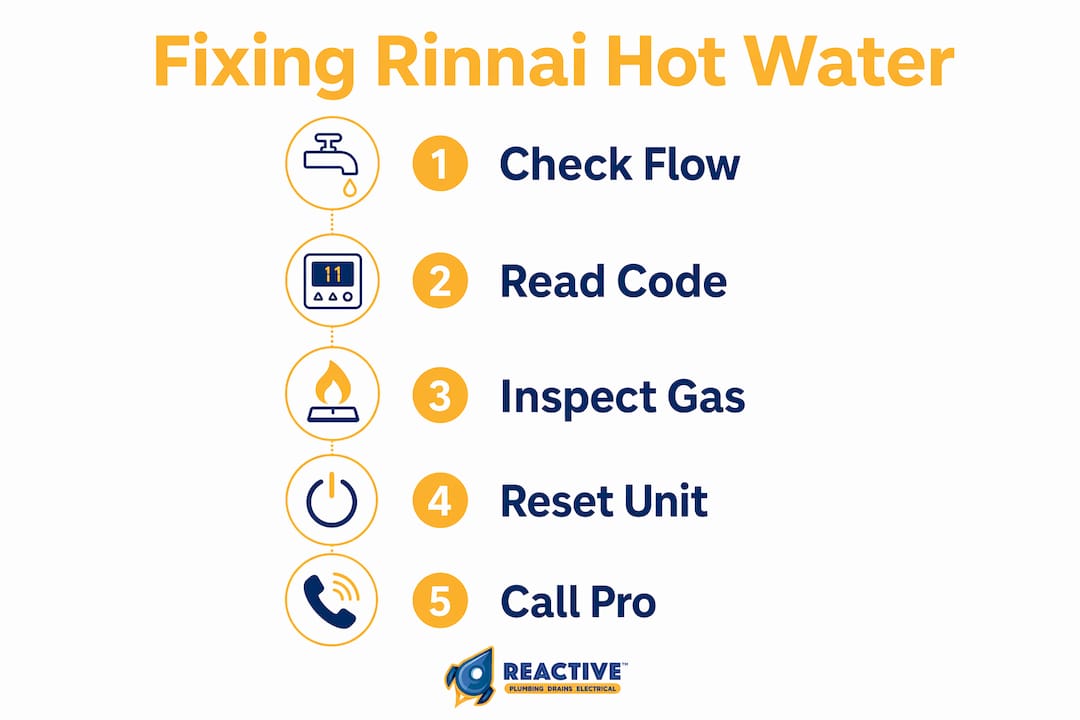
The good news is that the Rinnai troubleshooting workflow is genuinely logical once you follow it in order: confirm flow, check gas, read the code, reset once, and call a professional if the code returns. Most homeowners who follow that sequence either fix the problem themselves or arrive at a service call with a clear diagnosis, which saves time and money. For broader context on continuous flow system faults, our Rheem hot water troubleshooting guide covers similar diagnostic principles that apply across tankless brands.
Don’t let a cold shower turn into a week-long problem. The steps in this guide cover the vast majority of Rinnai no hot water scenarios. If you’ve worked through them and the fault persists, that’s when you call in a professional. Not before, and not after another five resets.
— Brent
Reactive Plumbing & Electrical can restore your hot water today
If you’ve worked through the checks above and your Rinnai system still isn’t producing hot water, it’s time to bring in a licensed professional. Reactive Plumbing & Electrical specialises in hot water system repairs across Sydney, Newcastle, Wollongong, Brisbane, and the Gold Coast, with technicians experienced in Rinnai tankless unit faults including ignition failures, flow sensor issues, and heat exchanger descaling.
We offer 24/7 emergency hot water services because we know a cold shower at 6am isn’t something you want to wait three days to fix. Our team arrives with the diagnostic tools and parts to get your system running on the first visit. If you need a repair, replacement, or a scheduled maintenance service for your Rinnai unit, our hot water system specialists are ready to help. Call us today for a fast, reliable assessment.
FAQ
Why is my Rinnai producing cold water with no error code?
If there is no error code displayed on your Rinnai hot water system, the most likely cause is insufficient water flow. Check that the cold water inlet filter is clean and that tap aerators are not scaled, as flow below the activation threshold prevents the burner from firing without triggering a fault code.
What does Rinnai error code 12 mean?
Error code 12 indicates flame failure, meaning the burner ignited but the flame was not sustained. Common causes include low gas pressure, a dirty burner, incorrect venting, or a faulty flame sensor. A licensed gas technician should inspect the unit if a reset does not clear the fault.
How do I reset my Rinnai hot water system?
For a full reset, switch the unit off at the circuit breaker or unplug it from the wall and wait 10 minutes before restoring power. Simply pressing ON/OFF without cutting power does not fully reset the PCB on most Rinnai models.
How often should I service my Rinnai tankless unit?
Rinnai recommends an annual service for most residential tankless units, with more frequent descaling in hard water areas. Cleaning the inlet filter every six months and checking tap aerators regularly reduces the risk of flow-related no hot water faults between professional services.
Can I fix a Rinnai ignition fault myself?
You can check the gas valve, power supply, and flue for obvious blockages, and perform a reset. However, any work involving the gas valve, burner, or flame sensor must be carried out by a licensed gas fitter. Attempting to repair gas components without a licence is illegal in Australia and creates a serious safety risk.