How to create a plumbing maintenance schedule for your business
A plumbing maintenance schedule is a structured programme of regular inspections, servicing, and compliance checks designed to keep your building’s plumbing system reliable and cost-effective. For small business owners and property managers, the decision to create a plumbing maintenance schedule for your business is not optional. It is a legal and operational necessity under Australian Standard AS 3500 and state-based water authority requirements. A well-built schedule prevents burst pipes, blocked drains, and compliance notices from catching you off guard. It also gives you predictable costs instead of emergency callout fees that can run well into the thousands.
What does a plumbing maintenance schedule include?
A compliant plumbing maintenance schedule covers far more than fixing dripping taps. It organises mandatory compliance tasks, routine servicing, and long-term inspection cycles into a single, manageable calendar.
The core compliance tasks every business must include are:
- Backflow prevention device testing: Annual testing and certification of backflow prevention devices is mandatory under AS 3500. Test results must be submitted to your local water authority each year.
- Grease trap servicing: Commercial kitchens must service grease traps quarterly or biannually depending on council rules, kitchen size, and menu type. Councils actively enforce this and issue fines for neglect.
- Hot and cold water system inspections: Temperature checks, pressure testing, and inspection of tempering valves protect against Legionella risk and scalding.
- CCTV drainage surveys: Drainage CCTV inspections every 3–5 years detect structural pipe damage, root intrusion, and blockage risk before they become emergencies.
- Documentation and reporting: Maintenance documentation is a legal requirement. Every service visit must produce a formal report. Test certificates must be lodged with the relevant water authority.
| Compliance task | Frequency | Who requires it |
|---|---|---|
| Backflow device testing | Annual | Water authority, AS 3500 |
| Grease trap servicing | Quarterly or biannual | Local council |
| Hot water system inspection | Annual | AS 3500, state regulations |
| CCTV drainage survey | Every 3–5 years | Best practice, insurer |
| Formal service report | Every visit | Legal requirement |
Pro Tip: Keep a dedicated compliance folder, physical or digital, for every service certificate and test result. Insurers and councils can request these documents at short notice, and missing records can void your coverage.
How often should your business schedule plumbing maintenance?
Maintenance frequency is not a one-size-fits-all decision. Customising your schedule to match your building’s actual use and risk profile is the single most important factor in preventing emergency failures.
Australian industry practice groups commercial buildings into three usage tiers:
High-use sites (hospitality, aged care, gyms, food manufacturing): These buildings need quarterly plumbing visits as a minimum. A busy restaurant kitchen puts enormous strain on grease traps, drainage, and hot water systems every single day. A quarterly visit catches blockages and wear before they shut down your kitchen service.
Moderate-use sites (offices, retail, medical clinics): Biannual visits suit most office buildings and retail spaces. Washroom fixtures, water heaters, and drainage still need regular attention, but the volume of use is lower. A biannual schedule keeps systems compliant without over-servicing.
Low-use sites (storage facilities, small professional offices): An annual comprehensive assessment covers the basics. Even low-use buildings need backflow testing and a drainage check each year to meet AS 3500 obligations.
The starting point for any frequency decision is a baseline condition assessment. An initial comprehensive inspection identifies the age of your pipes, existing faults, and risk areas. Without this baseline, you are guessing at frequency rather than making an informed decision.
Pro Tip: If your building has recently changed use, for example from a retail shop to a café, reassess your maintenance frequency immediately. A change in use can shift you from a low-use to a high-use risk profile overnight.
How do you build and implement your plumbing service schedule?
Building a plumbing service schedule from scratch takes a methodical approach. Follow these steps to get it right.

Step 1: Create a full asset and equipment inventory
List every plumbing asset in your building. This includes all taps, toilets, urinals, hot water systems, grease traps, backflow prevention devices, stormwater drains, and sewer connections. Note the age, brand, and last service date for each item. This inventory becomes the foundation of your maintenance plan.
Step 2: Map your compliance calendar
Using your asset list, identify every task with a mandatory frequency under AS 3500 or your local council rules. Plot these tasks on a 12-month calendar. Backflow testing goes in the same month each year. Grease trap servicing slots in at the correct quarterly or biannual interval. This calendar is your legal minimum.
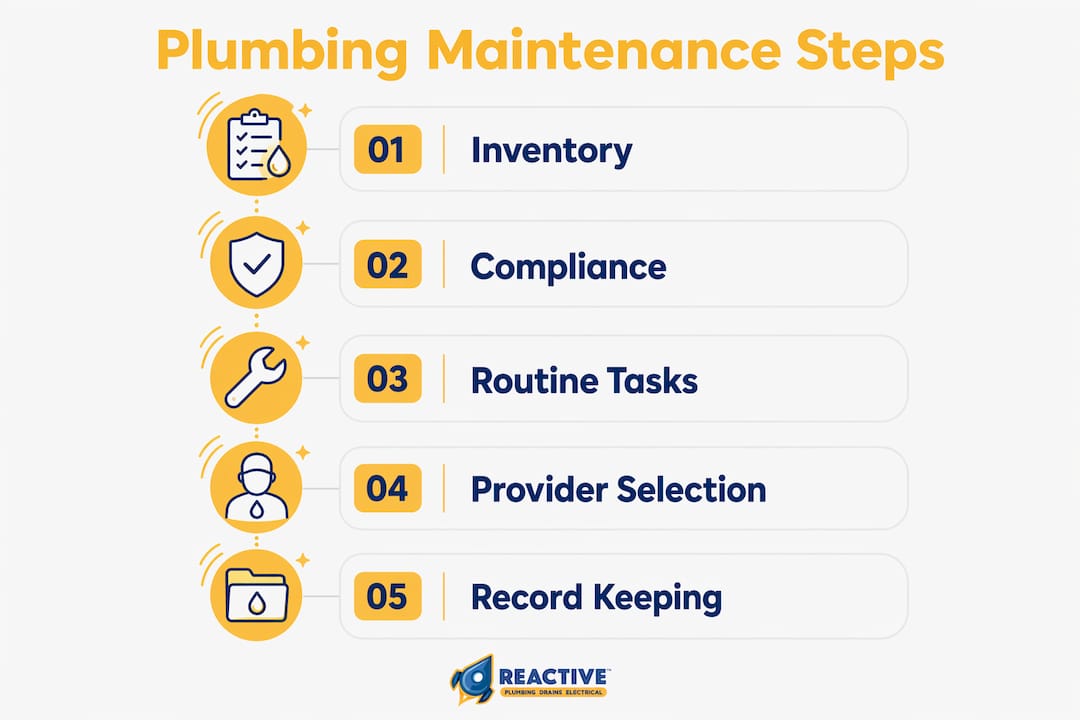
Step 3: Layer in routine servicing tasks
Add non-mandatory but high-value tasks around your compliance calendar. These include tap washer replacements, pressure checks, water filtration cartridge changes, and visual inspections of exposed pipework. Grouping these with compliance visits reduces callout costs.
Step 4: Select an experienced commercial plumbing provider
Provider quality directly affects your building’s performance and compliance standing. A residential plumber is not equipped for commercial maintenance work. Look for a provider with documented experience in commercial maintenance, a clear reporting process, and the ability to lodge compliance certificates on your behalf. Reactive Plumbing & Electrical offers commercial plumbing maintenance services built around compliance and documentation.
Step 5: Establish a record-keeping routine
Every service visit must produce a written report. Store reports, test certificates, and photos in a single location. Review your compliance calendar at the start of each financial year and update it if your building use or tenancy has changed.
Understanding preventive maintenance for plumbing helps property managers see why this record-keeping step is as important as the physical work itself.
What mistakes do businesses make with plumbing maintenance?
Most plumbing failures in commercial buildings are predictable. They happen because the maintenance approach was reactive rather than planned.
The most common mistakes are:
- Treating maintenance as repair-only: Many business owners only call a plumber when something breaks. Reactive repairs carry high costs including emergency callout fees, water damage, and lost trading hours. A planned schedule eliminates most of these costs.
- Ignoring documentation requirements: Skipping formal service reports is not just poor practice. It is a legal risk. Missing compliance certificates can trigger council notices, void insurance claims, and create personal liability for property managers.
- Using a generic schedule: A schedule copied from a template without reference to your specific building will miss critical tasks. Failure to customise leads to emergency failures that a tailored plan would have prevented.
- Neglecting long-term inspection cycles: CCTV drainage surveys are easy to defer because the problem is invisible. Skipping them for a decade means structural pipe damage goes undetected until a collapse forces an expensive excavation.
Plumbing maintenance is not a cost centre. It is an asset management strategy that enables predictable capital expenditure and protects your building’s long-term value. Businesses that treat it as an insurance policy spend less over time than those who wait for failures.
If a plumbing emergency does occur despite a good maintenance plan, knowing your priority repairs during an emergency can limit damage and downtime significantly.
Key takeaways
A structured plumbing maintenance plan, customised to your building’s use and risk profile, is the most cost-effective way to meet compliance obligations and prevent emergency repairs.
| Point | Details |
|---|---|
| Compliance is non-negotiable | AS 3500 mandates annual backflow testing, grease trap servicing, and formal documentation for all commercial buildings. |
| Frequency must match usage | High-use sites need quarterly visits; moderate-use sites need biannual; all sites need an annual comprehensive assessment. |
| Start with a baseline inspection | An initial condition assessment identifies existing faults and guides the correct maintenance frequency for your site. |
| Documentation protects you legally | Every service visit must produce a written report and certificate lodged with the relevant authority. |
| Provider selection matters | Choose a licensed commercial plumber with documented reporting practices, not a residential-only operator. |
Why I think most businesses get this completely wrong
From my experience working with commercial properties across Sydney and South East Queensland, the biggest mistake I see is not skipping maintenance entirely. It is treating the plumbing schedule as a box-ticking exercise rather than a genuine asset management tool.
Business owners often sign up for the cheapest annual visit they can find, get a basic report, and file it away. Then they wonder why they are paying for an emergency drain clearing job six months later. The truth is that a cheap, generic schedule often costs more than no schedule at all, because it creates a false sense of security.
What actually works is building a schedule around your specific building, then sticking to it with a provider you trust to tell you the truth. A good commercial plumber will flag a deteriorating pipe during a routine visit and give you time to budget for the repair. That relationship, built on honest reporting and consistent visits, is worth far more than the lowest quote you can find.
I also think the documentation requirement is underestimated. Property managers who keep thorough records have a genuine advantage when insurance claims arise or when a council inspector comes knocking. The paperwork is not bureaucracy. It is your protection.
— Brent
Reactive Plumbing & Electrical: tailored maintenance plans for your property
Reactive Plumbing & Electrical builds customised plumbing maintenance plans for small businesses and property managers across Sydney, Newcastle, Wollongong, Brisbane, Ipswich, and the Gold Coast. Every plan is designed around your building’s specific use, compliance obligations, and risk profile.
Our licensed team handles everything from backflow device testing and grease trap servicing to CCTV drainage surveys and full compliance documentation. We lodge certificates on your behalf and provide clear written reports after every visit. For properties with ageing pipework, our pipe relining services offer a cost-effective alternative to excavation and full pipe replacement. Contact Reactive Plumbing & Electrical to discuss a maintenance plan built for your property.
FAQ
What is a plumbing maintenance schedule for a business?
A plumbing maintenance schedule is a structured calendar of regular inspections, servicing tasks, and compliance checks for a commercial building’s plumbing system. It covers mandatory tasks under AS 3500 and local council requirements, as well as routine servicing to prevent failures.
How often should commercial plumbing be serviced?
High-use sites such as restaurants and aged care facilities need quarterly visits. Offices and retail spaces typically need biannual servicing. All commercial buildings require at least one comprehensive annual assessment to meet AS 3500 compliance obligations.
What compliance tasks must be included in a commercial plumbing schedule?
Mandatory tasks include annual backflow prevention device testing with results submitted to the water authority, grease trap servicing at council-specified intervals, hot water system inspections, and CCTV drainage surveys every 3–5 years.
Is plumbing maintenance documentation legally required in Australia?
Yes. Formal service reports, test certificates, and compliance records are legally required under AS 3500 and state regulations. Missing documentation can result in council notices, insurance issues, and personal liability for property managers.
Can I use a generic plumbing maintenance checklist for my business?
A generic checklist is a starting point only. An effective plumbing maintenance plan must be customised to your building’s specific use, age, and risk profile. A one-size-fits-all approach misses site-specific risks and frequently leads to emergency failures.