Why water leaks worsen without repairs: the real cost
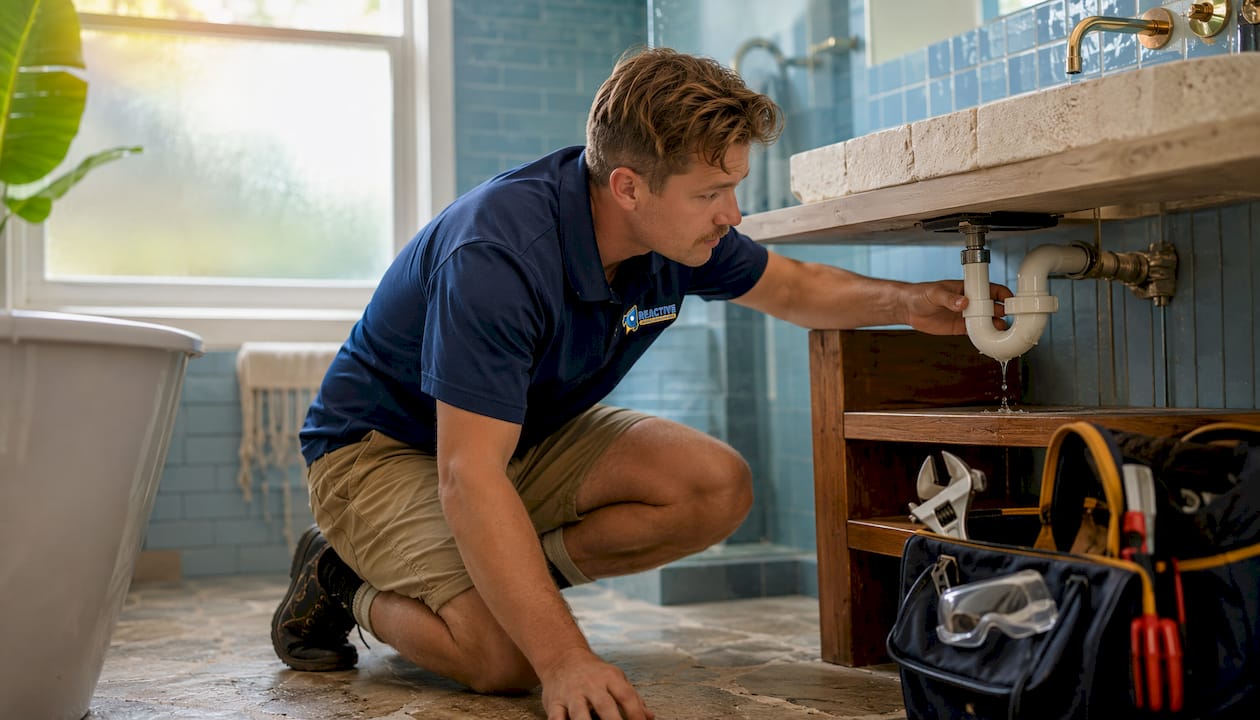
Water leaks worsen without repairs because moisture never stays still. It spreads, saturates, and silently breaks down everything it touches, from timber framing to concrete slabs, long before you see a single stain on the ceiling. Left untreated, what starts as a dripping pipe joint can escalate into structural failure, a mould-contaminated home, and an insurance claim that gets rejected outright.
Here is what happens when a leak goes ignored:
- Structural components weaken progressively as moisture saturates timber, concrete, and metal
- Mould can begin growing within 24–48 hours of moisture exposure, creating serious health risks
- Water bills climb steadily as even small leaks waste thousands of litres monthly
- Hidden leaks track along beams and joists, causing damage far from the original source
- Insurance policies often exclude gradual deterioration, leaving homeowners to cover costs themselves
Why water leaks worsen without repairs: from drip to disaster
A slow leak rarely announces itself. Water finds the path of least resistance, seeping into wall cavities, beneath floor slabs, and along structural timbers before any visible sign appears. Water damage can remain hidden for months or even years while structural integrity quietly deteriorates.
The progression follows a predictable pattern:
- Timber framing absorbs moisture and begins to rot, losing load-bearing capacity over time
- Concrete foundations and slabs degrade as prolonged saturation causes cracking and spalling
- Water seepage causes measurable strength loss in structural elements, with areas affected by spalling showing an average strength loss of 40.18% compared to unaffected areas
- Metal reinforcement within concrete corrodes, further reducing structural integrity
- Seasonal changes accelerate the damage: summer heat dries and contracts saturated materials, while winter moisture re-saturates them, widening cracks with each cycle
Australian homes face particular pressure from our climate extremes. The wet season in Queensland and the storm season along the NSW coast push water into any existing weakness. What was a hairline crack in a slab becomes a conduit for ongoing ingress.
Pro Tip: If you notice a door jamb swelling or a window frame weeping moisture, treat it as a structural warning, not just a cosmetic issue. In the Victorian case of Bird v Expo Constructions, water had been penetrating a home’s framework since construction in 2010, with visible damage only appearing six years later.
Mould, health risks, and the costs that follow
Mould does not wait. International health protection agencies confirm that mould can develop within 24–48 hours in areas with excess moisture, and once it takes hold inside a wall cavity or under flooring, it spreads rapidly without any visible warning.
The health consequences are well documented:
- Mould exposure worsens asthma, allergies, and respiratory conditions, particularly in children and the elderly
- Musty odours and visible discolouration are late-stage signs; contamination is often already extensive by then
- Complex mould growth, typically anything larger than 1 square metre or involving contaminated water, requires specialist remediation contractors alongside plumbing repairs
- Remediation costs compound quickly once mould spreads through multiple rooms or into HVAC systems
Beyond the health impact, persistent moisture creates legal and insurance exposure. In strata properties across NSW, delays in repairing water ingress have led to lost rental income, legal disputes, and extensive remediation bills. The WA Department of Health recommends that indoor humidity be controlled to avoid high levels for extended periods, and that water damage be addressed as soon as it is identified.
How to spot hidden leaks before they become serious
Visible damp patches are often only the surface symptom of a much deeper problem. Minor leaks frequently conceal more serious moisture intrusion hidden within wall cavities or beneath concrete slabs, and the damage accumulates long before you find it.
Watch for these signs:
- Unexplained increases in your water bill, or a meter that keeps moving when all taps are closed
- Damp patches, water stains, or peeling paint on walls and ceilings
- Musty smells in rooms with no obvious source of moisture
- Fluctuating water pressure throughout the property
- Soft or spongy flooring, particularly near bathrooms, laundries, or kitchens
Common leak locations in Australian homes include pipe joints under sinks, behind shower recesses, beneath concrete slabs, around hot water systems, and at roof penetrations. Water rarely travels vertically only. It tracks along beams, joists, and wall framing, which means the visible damage often appears metres away from the actual source. Patch repairs that do not address the true origin simply delay the next failure.
Why early detection and repair protects your home and your wallet
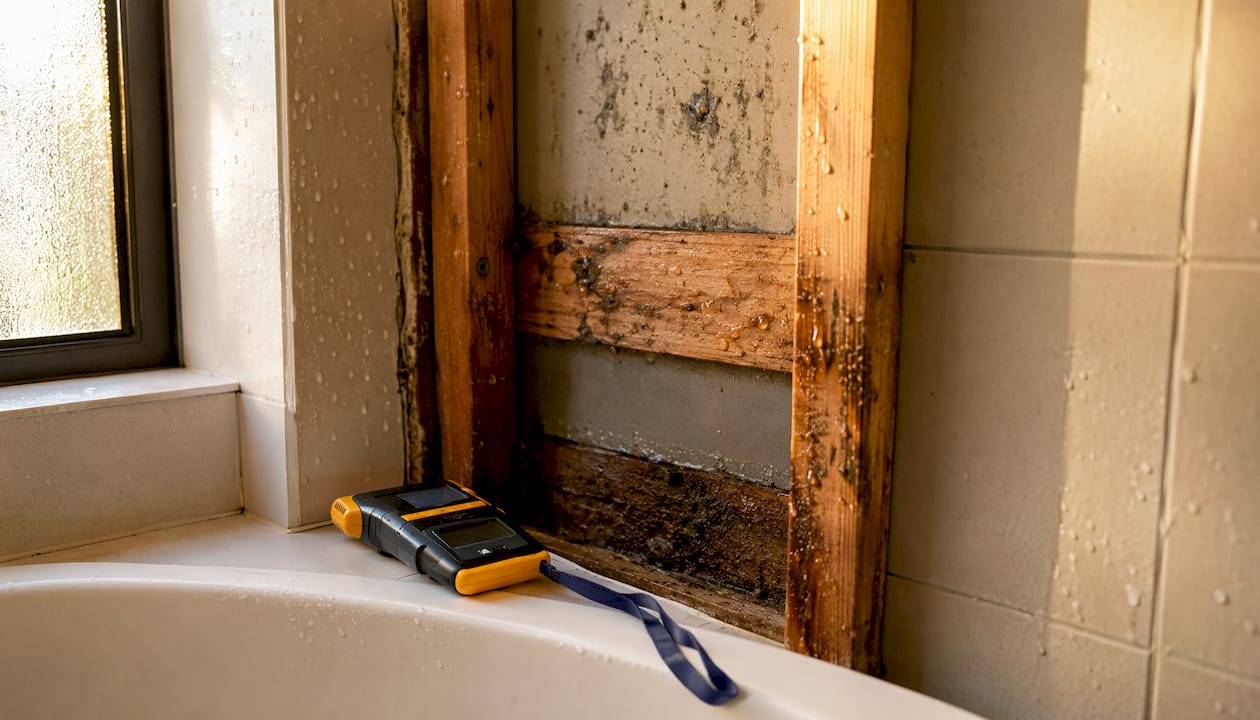
Acting early is almost always cheaper. Addressing a minor leak may require nothing more than a pipe fitting replacement or a resealed joint. Wait until water damage spreads through a building and the scope expands to structural drying, material replacement, mould remediation, and potentially foundation repairs.
The financial case for early action is clear:
- Small leaks can waste thousands of litres of water monthly, with the cost showing up directly on your bill
- Early repairs preserve property value; visible water damage and mould history reduce it
- Proactive maintenance keeps insurance claims viable, whereas long-term neglect does not
- Professional leak detection services use acoustic equipment and thermal imaging to locate hidden leaks without opening walls unnecessarily
A licensed plumber can assess the full extent of moisture intrusion, not just the visible symptom. We see it regularly: a homeowner calls about a damp patch under a window, and the actual source turns out to be a failed pipe joint two metres away inside the wall cavity.
What insurance actually covers, and what it does not
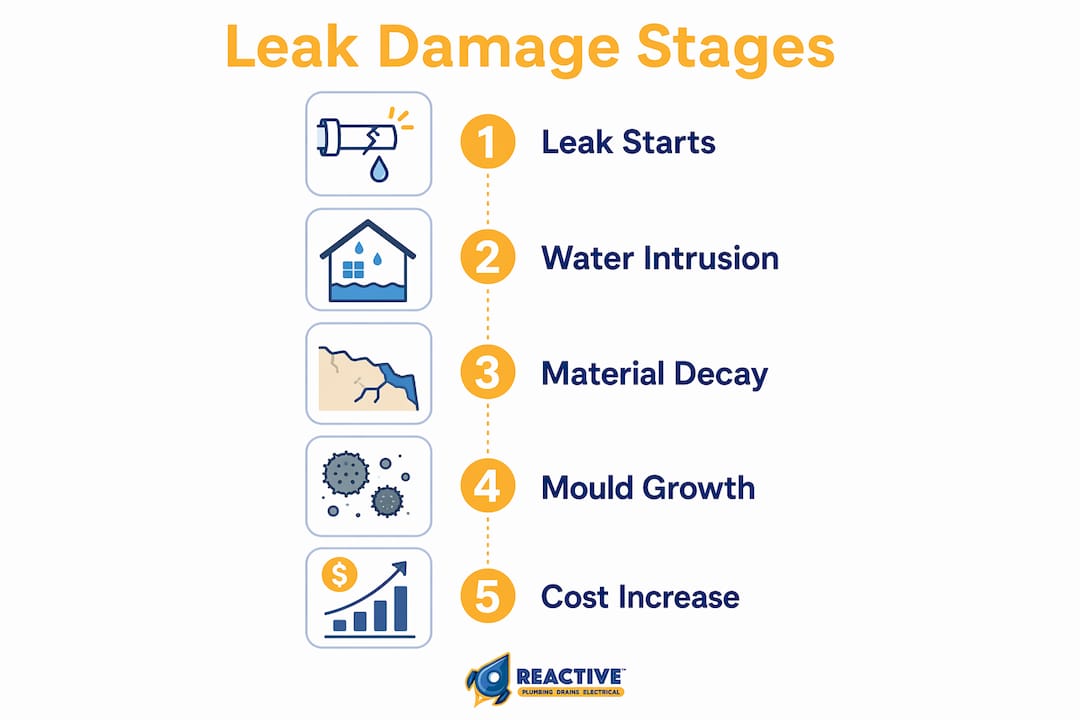
Most Australian building insurance policies draw a hard line between sudden damage and gradual deterioration. Insurance policies typically exclude damage caused by long-term leaks classified as maintenance failure, but damage that develops over days or weeks may still be covered if reported promptly.
The distinction matters enormously in practice:
- Damage occurring over months or years is generally treated as a maintenance failure and excluded from cover
- Damage developing over days or weeks from an acute event may be covered if you report it quickly
- Insurers often reject claims when homeowners cannot document when the leak was first noticed
- Documenting the discovery date of a leak is one of the most practical steps you can take to protect your claim
Photograph any visible damage the moment you find it, note the date, and call a licensed plumber the same day. That paper trail can be the difference between a successful claim and an out-of-pocket repair bill.
How building materials break down under prolonged moisture
Different materials in your home react to water in different ways, but none of them improve with prolonged exposure. Understanding how water-induced deterioration progresses helps explain why the effects of ignoring water leaks compound so quickly.
Timber absorbs moisture and swells, then dries and contracts, creating movement that loosens fixings and opens joints. Repeated cycles lead to rot, particularly in structural members that cannot dry out between wet periods. Plasterboard softens and crumbles when wet, losing its structural contribution and providing an ideal surface for mould. Concrete is porous, and sustained moisture causes the steel reinforcement inside to corrode; as rust expands, it cracks the surrounding concrete from within, a process called spalling. Paint and render blister, peel, and flake as moisture migrates through the substrate beneath them. Waterproofing membranes in wet areas degrade over time, and once they fail, water tracks freely into the structure behind tiles and screeds.
The consequences of water damage on building materials are rarely limited to one element. When one material fails, it typically accelerates the failure of everything adjacent to it.
How leaks affect insulation and your energy bills
Wet insulation is effectively useless insulation. Whether your home uses glasswool batts, polyester, or foam board, moisture destroys the air pockets that give insulation its thermal performance. Once saturated, insulation compresses, clumps, and in some cases grows mould through its entire thickness.
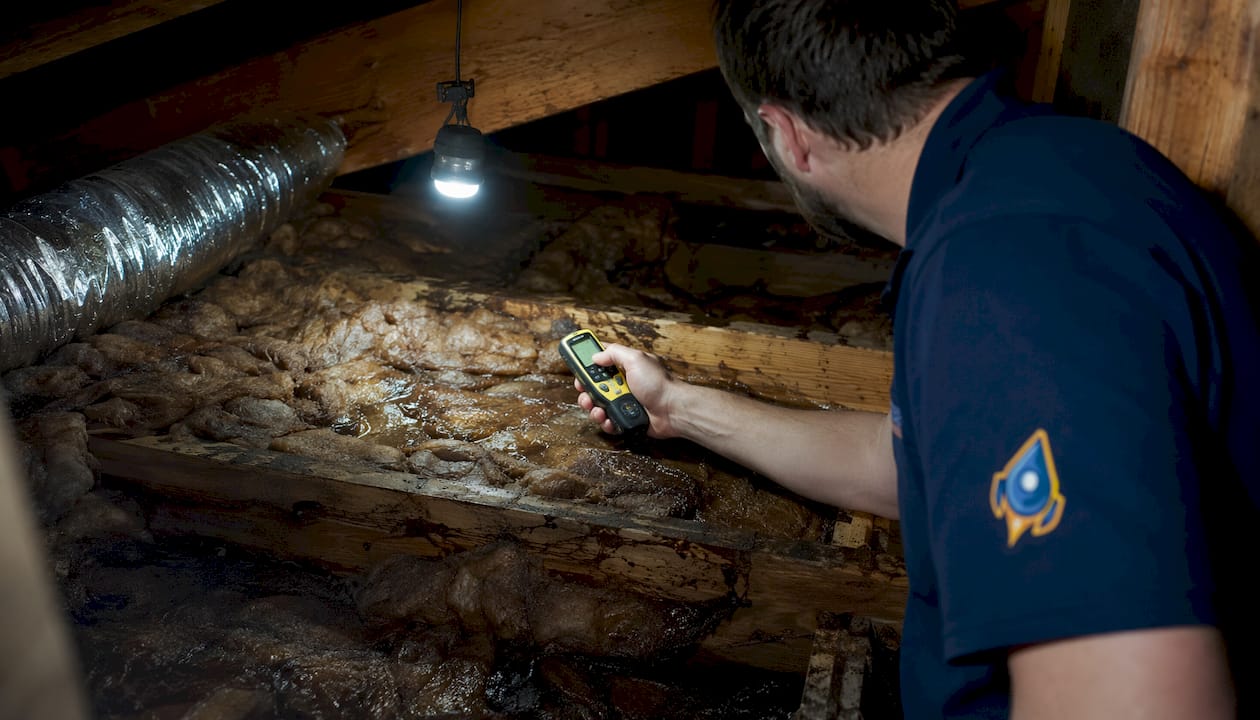
The practical result is a home that costs more to heat in winter and cool in summer. Your ducted air conditioning or reverse-cycle system works harder to compensate for the lost thermal barrier, and the energy bills reflect it. In Australian homes where ceiling insulation is the primary defence against summer heat, a leak through the roof that saturates the batts can meaningfully increase cooling costs within a single season. Replacing wet insulation also adds to the total cost of water damage repairs, a line item that surprises many homeowners who assumed the leak was only a plumbing problem.
Water near wiring: the electrical hazard you cannot ignore
Water and electricity are a dangerous combination, and a leak inside a wall or ceiling can reach electrical wiring, junction boxes, and light fittings without any visible warning. When water contacts live wiring, the risks include short circuits, tripped safety switches, damaged appliances, and in serious cases, electrical fires or electrocution.
Australian homes built before the 1990s may have older wiring that lacks the protection of modern insulation standards, making them more vulnerable when moisture is present. A leak near a switchboard or sub-board is a particular concern, as moisture ingress into electrical enclosures can cause arcing and corrosion that compromises the entire circuit. If you suspect a leak is near any electrical installation, treat it as an emergency. Switch off the relevant circuit at the switchboard, and arrange both a licensed plumber and a licensed electrician to assess the situation. Reactive Plumbing & Electrical handles both, which means one call covers the full scope of the problem. You can also book an electrical safety check to confirm your wiring is unaffected after any water ingress event.
Ready to stop a small leak before it becomes a big repair?

At Reactive Plumbing & Electrical, our licensed plumbers and electricians serve homeowners across Sydney, Newcastle, Wollongong, Brisbane, Ipswich, and the Gold Coast. We use professional leak detection equipment to find the source, not just the symptom, and we carry out repairs the same day wherever possible.
Whether you need a pipe relining solution for a damaged sewer or stormwater line, or you need a plumbing emergency assessed right now, we are available 24/7. Call us today and let us sort it before the damage goes any further.
Key takeaways
Unrepaired water leaks cause progressive structural, health, and financial damage that compounds over time, making early detection and prompt repair the most cost-effective approach for any Australian homeowner.
| Point | Details |
|---|---|
| Mould grows fast | Mould can develop within 24–48 hours of moisture exposure, spreading through wall cavities before it becomes visible. |
| Structural strength drops measurably | Areas affected by spalling from water seepage show an average strength loss of 40.18% compared to unaffected structural elements. |
| Insurance has strict limits | Damage from gradual deterioration over months or years is typically excluded; document the discovery date immediately to protect your claim. |
| Hidden leaks track far from the source | Water travels along beams and joists, so visible damage often appears metres away from the actual leak origin. |
| Wet insulation loses its thermal value | Saturated insulation compresses and fails, increasing heating and cooling costs and adding to the total repair bill. |
FAQ
Do leaks always get worse over time?
Yes. Water follows the path of least resistance, and without repair, the opening grows, surrounding materials degrade, and the leak spreads to new areas. There is no such thing as a stable, self-limiting leak.
Can a water leak come and go?
A leak can appear intermittent if it is pressure-dependent or triggered by specific usage, such as running a shower or a heavy rainfall event. The underlying fault does not resolve between episodes, and the cumulative moisture damage continues to build.
What happens if you don’t fix a leak promptly?
Structural components weaken, mould develops within 24–48 hours of sustained moisture exposure, water bills increase as wastage accumulates, and insurance cover may be voided if the damage is later classified as gradual deterioration from a maintenance failure.
How long does it take for a leak to cause water damage?
Mould can begin within 24–48 hours. Timber rot and concrete spalling develop over weeks to months of sustained exposure. Water damage can remain hidden for months or years before visible signs appear, by which point major repairs are typically required.
How do I know if I have a hidden leak?
Watch for unexplained increases in your water bill, a water meter that moves when all taps are closed, damp patches or musty smells with no obvious source, and soft or discoloured patches on walls, ceilings, or flooring. A licensed plumber with leak detection equipment can confirm the source without unnecessary damage to your home.